
Millions of British households now stream TV through the internet instead of a traditional aerial or satellite dish.
But one question keeps popping up in forums, Facebook groups and family WhatsApp chats: is IPTV legal UK viewers should worry about?
The honest answer isn’t a simple yes or no. It depends entirely on what you’re watching and where that content comes from.
This guide breaks down the technology, the law, and your responsibilities as a viewer—without the scaremongering or the vague answers you’ll find elsewhere.
What Is IPTV and How Does It Actually Work?
IPTV stands for Internet Protocol Television. Instead of receiving channels through satellite or terrestrial signals, IPTV delivers content through your internet connection.
Think of it like this: traditional TV broadcasts to everyone at once, like a radio tower. IPTV sends data directly to your device, similar to how Netflix or YouTube works.
If you want a deeper technical breakdown, our guide on how IPTV technology actually works explains the full process step by step.
Here’s the key point many people miss: IPTV is just a delivery method. It’s not inherently legal or illegal. A knife can cut bread or cause harm—context matters.
The same logic applies here. BBC iPlayer uses IPTV technology. So do thousands of unlicensed streaming services. The technology is identical. The legality depends on something else entirely.
Is IPTV Legal UK? The Short Answer
Yes, IPTV itself is completely legal in the UK. There’s no law against streaming television through your internet connection.
What determines legality is whether the content provider has the rights to broadcast that content.
Services like BBC iPlayer, ITVX, Channel 4’s platform, and Amazon Prime Video all use IPTV technology. Nobody questions their legality because they’ve paid for proper licensing.
The problem arises with services offering hundreds of premium channels, live sports, and newly released films for a fraction of the normal cost. These services often don’t hold the rights to distribute that content legally.
Legal IPTV Services in the UK
Let’s clear up the confusion with some concrete examples.
Fully legal IPTV platforms include:
- BBC iPlayer
- ITVX
- Channel 4 (My4)
- Sky Go (with a valid subscription)
- Amazon Prime Video
- Disney+
- Now TV
These platforms pay broadcasters, studios and sports leagues for the right to show their content. That licensing fee is baked into your subscription price.
When you pay for Now TV or Sky Go, part of that money goes back to the people who created or own the content you’re watching.
What Makes an IPTV Service Illegal?
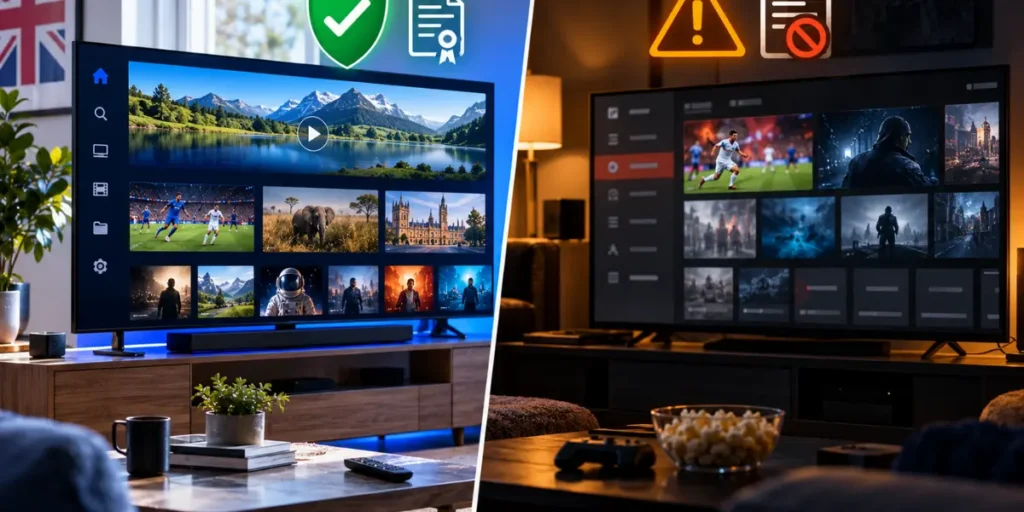
This is where things get serious, and where most confusion starts.
An IPTV service becomes illegal when it broadcasts content without permission from the copyright holder.
Live Premier League matches, for example, are protected by strict broadcasting rights. Sky Sports and TNT Sports pay enormous sums for exclusive access. If a cheap IPTV subscription offers you every match for a few pounds a month, that content almost certainly hasn’t been licensed.
The same applies to newly released films still in cinemas, or entire channel packages copied from legitimate broadcasters.
To understand why this matters so much, our detailed page on content licensing and copyright rules explains how rights holders protect their investment—and why unauthorised streaming undermines the entire industry.
Here’s a simple rule of thumb: if a deal looks too good to be true, it probably involves copyright infringement.
The Risks of Using Illegal IPTV Services
Many people assume that using an illegal IPTV service only risks a slap on the wrist. That’s not accurate, and it’s worth understanding the real consequences.
Legal Risks
Knowingly accessing pirated content can expose you to legal action. While prosecutions typically target sellers and distributors rather than individual viewers, the law doesn’t fully protect consumers either.
The UK government has published clear guidance on this topic through its illicit streaming devices information page, which outlines how enforcement works against unauthorised devices and services.
Security Risks
Illegal IPTV apps often require you to install software from unknown sources. This frequently means disabling built-in security protections on your device.
Malware, data theft and unauthorised access to your home network are common problems linked to these services.
Unreliable Service
Because illegal services operate outside normal business structures, they shut down unpredictably. Customers often lose access overnight with no refund and no support.
Poor Streaming Quality
Legitimate broadcasters invest heavily in reliable servers and content delivery networks. According to Ofcom’s research on UK broadband performance, consistent streaming quality depends heavily on proper infrastructure—something illegal services rarely maintain.
How to Check If an IPTV Service Is Legal
You don’t need to be a legal expert to spot warning signs. Ask yourself these questions before subscribing to anything.
Does the price make sense?
If a service offers every Sky Sports channel, BT Sport, and 1000+ international channels for less than £15 a month, be sceptical.
Does the company have a registered UK business address?
Legitimate providers list company details, VAT numbers and contact information. Vague “contact us on Telegram” setups are a red flag.
Can you find reviews outside their own website?
Search for independent reviews on trusted forums. Scam services often have no genuine online presence beyond their own marketing.
Do they offer customer support with accountability?
Legal businesses provide proper support channels, refund policies and terms of service.
Is the content delayed or does it include live sports without licensing deals?
If a provider streams live Premier League football without any visible broadcasting agreement, that’s a strong sign the content is unauthorised.
UK Law and Illicit Streaming Devices
The UK takes content piracy seriously, particularly when it comes to devices sold specifically to access unauthorised streams.
Selling, advertising, or configuring devices for illegal streaming is a criminal offence under UK law. This includes pre-loaded “Kodi boxes” or IPTV set-top devices marketed for pirated content.
According to government guidance, sellers of illicit streaming devices can face prosecution, fines, and in serious cases, imprisonment.
For consumers, the legal picture is less clear-cut, but that doesn’t mean there’s no risk. Copyright holders have increasingly pursued legal action against individuals who knowingly access pirated sports streams, particularly through organisations representing the Premier League.
If you want to understand your broader consumer rights and legal protections, Citizens Advice provides free, independent guidance on UK law that applies to everyday situations like this.
What Happens If You Get Caught Using Illegal IPTV?
Enforcement in the UK has mostly focused on sellers and distributors rather than individual households. However, the situation is evolving.
Internet service providers can be required to block known piracy websites through court orders. If you’re accessing one of these blocked services, you may notice sudden connection failures.
Rights holders, particularly in sports broadcasting, have also started sending warning letters to households identified through IP address tracking linked to illegal streams.
While a criminal conviction for simply watching an illegal stream remains uncommon, it’s not impossible. The legal landscape is tightening, not loosening.
Tips for Staying on the Right Side of the Law
Protecting yourself doesn’t require technical expertise. It just requires a bit of common sense.
- Stick to well-known, established streaming platforms
- Check whether a service clearly states its licensing agreements
- Avoid apps that require sideloading from unofficial app stores
- Be wary of IPTV sellers advertising through social media DMs
- Research the company behind any subscription service
- Trust your instincts—unrealistic pricing usually means unrealistic risk
If you’re unsure whether a specific channel package is legitimate, a quick search often reveals whether other users have reported problems.
Does a Fast Internet Connection Affect Legal IPTV Viewing?
This is a practical question many people ask once they understand the legal side.
Yes, your internet speed directly impacts streaming quality, regardless of whether the service is legal or not.
HD streaming typically requires at least 5-10 Mbps per device, while 4K content demands considerably more bandwidth. Legitimate services like BBC iPlayer adjust quality automatically based on your connection, giving you a stable (if sometimes lower-resolution) viewing experience.
Illegal services, by contrast, often lack this adaptive technology, leading to frequent buffering regardless of your broadband speed.
Frequently Asked Questions
Is it illegal to watch IPTV in the UK?
Watching IPTV itself isn’t illegal. However, accessing content through services that don’t hold proper broadcasting rights can expose you to legal and security risks.
Can I go to prison for using IPTV?
Individual viewers rarely face prosecution, but sellers and distributors of illegal streaming devices can face criminal charges, including imprisonment in serious cases.
How do I know if an IPTV service is legal?
Check for a registered business address, transparent pricing, proper customer support, and clear licensing information. Prices that seem too low for premium content are a major warning sign.
Are all IPTV boxes illegal?
No. IPTV boxes themselves are legal hardware. They only become problematic when pre-configured specifically to access pirated content.
Final Thoughts
So, is IPTV legal UK viewers need to understand properly? The technology is completely legal. The legality always comes down to content licensing.
Stick with established, transparent providers, and you’ll avoid both legal trouble and the security risks that come with unregulated services.
When in doubt, remember this simple principle: legitimate services are open about their licensing. Illegal ones hide it.
Staying informed is the best protection you have as a UK streaming consumer in 2026 and beyond.